Happy New Year, and Remembering the American Dream
Happy New Year, dear friends!
Yes, I know January is almost over. I know terrible things have happened this month. I know going from 2025 to 2026 feels A LOT like going ‘out of the frying pan, and into the fire’ (If you like etymology, here is the history behind that idiom).
Still, Happy New Year anyway. In spite of everything going on, this time of year did for me what it always does, which is give me an opportunity to return to a place of clarity. To remember the people, and goals, that are important to me.
Leaning in to the desire to focus and regroup is one of the most powerful things we can do right now. We are living in a period of time where, if you are in the U.S., the federal government wants to keep us afraid and confused. They want us to stop functioning. But, claiming ownership of our mind, priorities, and focus means we keep functioning. So, keep functioning, friends.
Some of things at the top of my mind this year are to…
- Continue to build and grow a community of friendship and support in my neighborhood and among the people in my life.
- Write my fantasy novel, and maybe finish a poetry collection, too.
- Spend quality time with my husband and my daughter, to love them both and to help lift up their dreams and goals.
- Get more involved in the grassroots organization taking place in my home city and state.
What are some things that are most important to you at the start of 2026?
Remembering the “American Dream”
In my last newsletter, I said I would share some art I’ve come across and enjoyed each week. Well, the “each week” part hasn’t happened yet, but better late than never (I hope 😅). Please forgive me for the delay.
Over the holidays, my brother-in-law gave me, American Sonnets: an anthology by David Bromwich, as a Christmas gift. He shared one of his favorite poems from the collection with me, and I realized as soon as I started reading that I recognized it. I think you’ll find you recognize at least some of the lines, too.
The New Colossus
by Emma Lazarus
Not like the brazen giant of Greek fame,
With conquering limbs astride from land to land;
Here at our sea-washed, sunset gates shall stand
A mighty woman with a torch, whose flame
Is the imprisoned lightning, and her name
Mother of Exiles. From her beacon-hand
Glows world-wide welcome; her mild eyes command
The air-bridged harbor that twin cities frame.
“Keep, ancient lands, your storied pomp!” cries she
With silent lips. “Give me your tired, your poor,
Your huddled masses yearning to breathe free,
The wretched refuse of your teeming shore.
Send these, the homeless, tempest-tost to me,
I lift my lamp beside the golden door!
Do you recognize this sonnet?
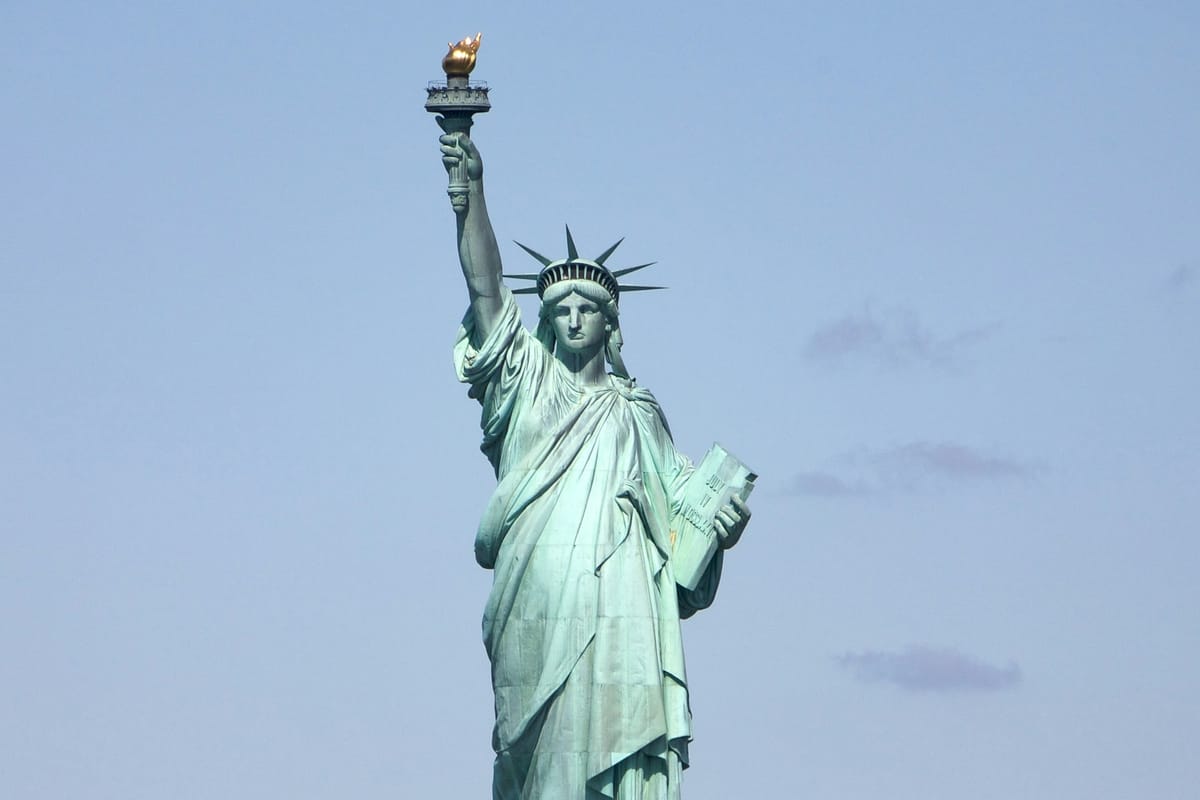
It's the full poem inscribed on the base of the Statue of Liberty.
Legacy and "Mother of Exiles"
“Mother of Exiles" is the name the poem gives to the woman depicted as The Statue of Liberty.
The author of this poem, Emma Lazarus, was born in New York City in 1849 to an elite, Sephardic-Jewish (Spanish Jewish) family. Lazarus was not an immigrant herself, yet identified with the plight of Jewish-immigrants fleeing persecution in the 19th century. She also empathized with the incoming Irish and German Catholic immigrants arriving in New York City during her lifetime. (Sources: Wikipedia, Gilder Lehrman)
At the time Emma Lazarus wrote, “The New Colossus”, women did not even yet have the right to vote. To put that another way, it was not legal for women to vote. It is remarkable, because many of us think of voting as 'using our voice.' At a time when she did not even have the legal right to a voice, Emma Lazarus used her voice in a powerful way to leave an enduring mark on the idea of the American Dream. (Source: Words and Worlds: Emma Lazarus's Conflicting Citizenships)
Many people in the U.S. continue to call immigrants “illegals.” It is a broad, generalizing, and dehumanizing way to refer to a large group of multifaceted people who have, like Lazarus, also left an enduring mark on this country. Immigrants in the U.S. are people from all over the world who have chosen the U.S. as their home. Many U.S. citizens have a relative or ancestor who was an immigrant in their families’ recent lineage. People who immigrate to the U.S., no matter how they arrived here, have contributed their hearts, minds, and bodies to make this country a better place for everyone. People immigrate here with their families believing in the American Dream. They come believing that this is a place where every person can live a life that is free from tyranny and oppression, where everyone has a right to self-determination. They come here knowing America’s history, our story, often better than our own citizenry.
The people who founded this country also came as immigrants. They came here fleeing religious persecution, poverty, and tyranny. When they arrived, they began to oppress, kill, and exile the original peoples living on this land. Our ancestors that wrote the constitution and overthrew imperial rule, founded this country on a land taken from the First Nations peoples who had lived here for centuries prior.
Today, we still have not properly acknowledged or repaid the First Nations for the harm our ancestors dealt them. In this light, the argument some Americans make today that undocumented immigrants should “come here the right way” rings hollow. If the “right way” means respecting and abiding by the way of life, law, and traditions of the people living on this land, then even our ancestors did not “come here the right way.”
Yet, in every way except the legality of a piece of paper, the immigrants who live here are Americans. They live, and work, and go to school alongside U.S. citizens; pay taxes, abide by laws, customs, and norms, and contribute to our communities. There is no difference between us, neighbors and friends, until a masked militia begins knocking on doors and demanding papers.
And, the Mother of Exiles, holding up a beacon of hope for the world to see, claims every immigrant in our country today, as her child.
Together, The Statue of Liberty and this poem, The New Colossus, symbolize an American ideal and a spirit of celebration toward immigrants that seems to have vanished from the hearts and minds of some Americans. Still, many others are empathizing with our brothers and sisters, and standing up in the face of injustice. Like Lazarus, many people today can see themselves, their family, their friends, their ancestors, in the faces of the people being targeted by ICE. Citizens in every state in the U.S. are using their privilege and voice to defend a people being persecuted.
The first half of Lazarus’ poem proposes that the Statue of Liberty will exist as a symbol for a nation that is different from the giants of empire that came before. She lifts up the U.S. as a giant standing ready not to enslave or persecute, but to defend “your tired, your poor, / your huddled masses yearning to breathe free…”
I, for one, and a multitude of others, still believe in this version of the American Dream. Not as an exalted ideal that we have lived up to in the past, but as a hope-filled legacy we can still claim for our future. Let us choose to live up to the name, “Mother of Exiles.”
“Send these, the homeless, tempest-tost to me, / I lift my lamp beside the golden door!”
Be well,
Kerri (K.P. Aldrich)